Incorporating AI in the Classroom: Using AI to Learn, and Learning the AI
This is the second post in my Incorporating AI in the Classroom series. More to come!
This term I’m using AI on purpose in 2 of the courses I teach at UBC. The first is my own course, DSCI 521: Computing Platforms for Data Science, in the Master of Data Science program. The second is SPPH 381H: Health Data Science: AI and Knowledge Translation. There are 2 things I want students to get out of AI in class. There’s using AI to learn something, and then there’s just doing stuff to learn the AI.
Using AI to learn something
The first thing is using AI to learn the course material itself.
What it looks like in class
In DSCI 521, this mostly happened in my review sessions. We’d go over the concepts, then watch an agent do a similar task using the same commands we had just talked about, which I think helped solidify them (I wrote about those sessions in my last post).
In SPPH 381H, we still go through the concepts, but then we go into AI-assisted coding, with GitHub Copilot in a GitHub Codespace. The course has no coding prerequisites, and students use Copilot’s free tier, where Auto picks the model for them. I drive Copilot in the class demos, but it’s to show students how they can use it themselves. The AI-KT teaching team also wrote a lot of AI prompts into the course materials that students can use with Copilot on their homework.
SPPH 381H isn’t my course. It’s an open course developed by Dr. M. Ehsan Karim of UBC’s School of Population and Public Health, with the AI-KT team (Manya Jain, Rainie Fu, and Md. Belal Hossain), and shared as “an open educational resource for learners and adopting instructors” (Karim et al. 2026). I’m the first instructor for the course, even though it was developed by all of these other people (I just happen to be a good instructional fit for teaching it). AI is built right into the course, and one of its goals is for students to use LLMs to “generate, debug, and translate code while critically auditing them for bias and hallucinations”.
A typical class goes like this: we teach a concept, students ask a research question, the code shows up, we try to read the code, and then we see the result. We already teach code in a similar way, even without AI: we teach a concept, show a more complicated example, have students guess what might happen, and then show them the result. A fuller version of this pattern is PRIMM (predict, run, investigate, modify, and make). I first read about it in Greg Wilson’s Teaching Tech Together (2019), and it comes from Sue Sentance and Jane Waite, who wrote it up with Maria Kallia (2019). I’m not using PRIMM in class right now: I mostly live code and demo things, with the agent helping me type a lot of it. But since AI frees up some class time, PRIMM is a format that can fit in, and now that we’re a month into the term, it’s something I’m considering.
What I’ve learned is that AI-assisted coding really cuts down on the time we spend talking about the details of the code. Since we aren’t stuck on the code, we can start thinking about the data and the next set of questions to ask of it. That reminds me of what Lucy D’Agostino McGowan, Stephanie Hicks, and Roger Peng call analytic design theory, “the study of how data analyses are conducted in the real world”. It was never really about the code, it’s about the thinking behind it. Copilot helps students write less code, and the point is for them to read more of it and assess it, which I think is a good thing.
We’ll see how well this works for students in the long term. That’s an open question for education in general, which is in an assessment crisis right now with AI.
Know what your tools can do
The flip side of letting AI write the code showed up in DSCI 521. One homework assignment had students filling in Quarto reveal.js slides, and some of the slides ended up with too much text. The assignment’s instructions said Quarto has a built-in option for exactly this, and where to find it in the documentation, but didn’t name it, on purpose. One student (using ChatGPT, the way they normally do) had it rewrite all of the CSS to work around the problem instead, when the fix was a one or two liner, Quarto’s .smaller class.
When I know the tool I’m using and where its documentation lives, I always feed that documentation to the LLM. LLMs can do a lot of this stuff for you, but you still need to know what your other tools (like Quarto) are already capable of, or the LLM is going to go off and do something you don’t want.
It happened to me while writing this post. I asked Claude for a fun way to define vibe coding, and it built a custom card from scratch, with about 40 lines of CSS and a bit of JavaScript. Quarto could already do it with a callout extension (that’s the vibe coding definition further down), and I only knew to ask for that because I know Quarto. I wrote it up as a learning moment, one of the examples I keep of correcting AI output.
Doing stuff to learn the AI
The other thing I want students to see is how these tools work. Most students only know how to talk to an LLM through a chatbot, not through a harness, and not as an agent (I went over what I mean by those in my last post). In SPPH 381H, I get a lot of cool head nodding (and some wide eyes) when the agent does something on its own. It’s such a different way of interacting with AI, and those eyes and nods tell me it’s worth showing.
Showing what’s under the hood
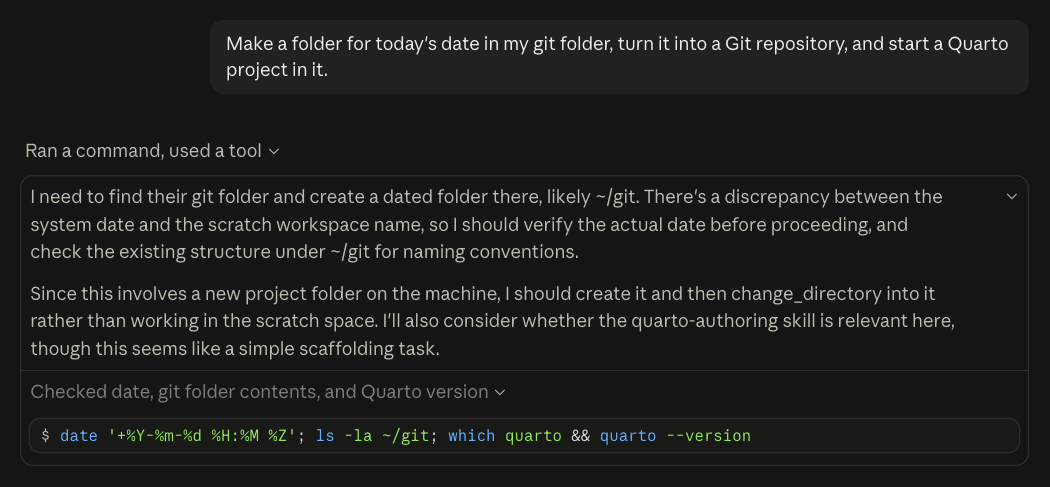
In DSCI 521, I ran one of my reviews in Claude Code on the desktop app, since it’s a little bit easier to toggle the model’s thinking on and off there. With the thinking visible, we could see how much text the model generates before it does anything, and all of that text is tokens, which is time and money. We also got to compare what it wrote while it was thinking with what it told us. I did this because of a September episode of Hard Fork (the New York Times podcast) about the incident where OpenAI’s AI agents hacked into Hugging Face. The investigators could read the AI agents’ thinking, and some of the agents were working out how to fake their own logs, so what the logs showed wasn’t always what the agents had actually done. The hack itself had nothing to do with DSCI 521, but it’s what got me wanting to show students what’s actually happening under the hood.
Building my own projects
But watching only goes so far, and much of what I know about how these tools behave came from building things for myself. I have a growing list of vibe-coded projects on my website, small tools and websites I built by pairing with an AI coding agent. I did the websites entirely in plan and auto mode, because I don’t know JavaScript, HTML, or CSS, and I’m not planning on learning them right now. I just wanted to build the cool projects I had in my head, and my subscription let me make something as soon as I thought of it.
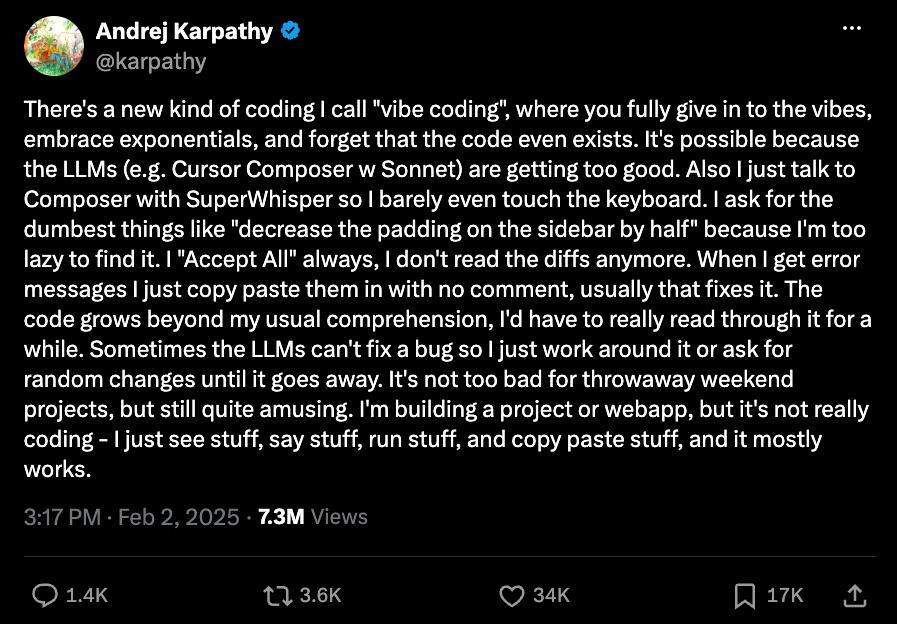
Andrej Karpathy’s term for coding where you “fully give in to the vibes, embrace exponentials, and forget that the code even exists.”
These projects are just the code I want to exist in the world for myself (and maybe they’ll be useful for other people), and sometimes I even get to bring in what I already know to direct them, mostly anything around Quarto and GitHub Pages deployments. If something goes wrong, it doesn’t really affect anyone else, which makes them a good place to try stuff out. That’s how I learned different ways to use an LLM, like Karpathy’s LLM wiki method, where an LLM keeps a wiki of your notes and sources up to date. I keep my teaching and learning notes in one, and I’ve moved my main Obsidian vault over too, using Claude to reorganize my projects and folders.
Why I want both
What I’m trying to show students is that you need to go and use these tools yourself to see what they’re actually capable of, and that’s separate from using them in my classroom to learn data science. It’s also why it’s fine for me to vibe code a website without knowing any CSS, but not for a student whose homework is about learning Quarto. In class, the code is the thing you’re learning to judge, while in my own projects it can stay out of sight. I understand a lot more of the language people use around agentic coding now, because I’ve done it myself.
Learning to use these AI tools was itself learning with an LLM, so it’s circular in a way. But they’re still 2 different things I want to expose students to, and 2 different ways to learn. The end goal, hopefully, is knowing both, so you can pick whichever fits the task at hand. Not everything you do with these tools has to be fully understood, and you can totally use them for fun.