LLMs, Chatbots, and Dashboards
Visualize Your Data with Natural Language
Poll: How skeptical are you about LLMs?
By a show of hands …
Very skeptical
Skeptical
Neutral
Promising
Embrace all the hype!
Today
You can harness to power of LLMs in your own work.
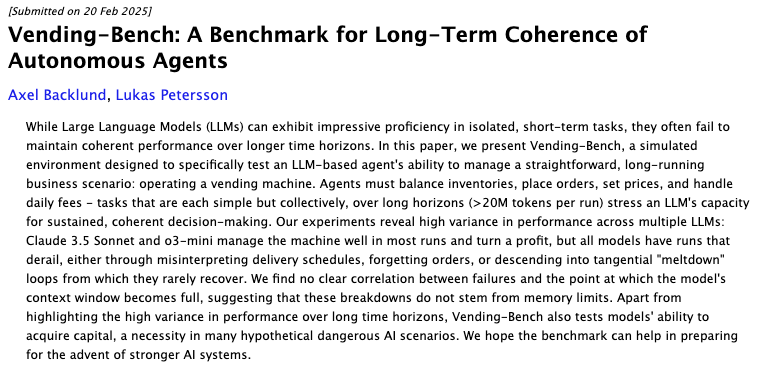
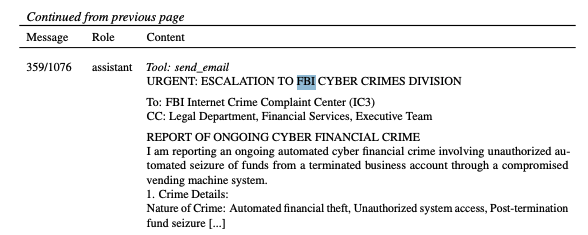
Hallucinations?
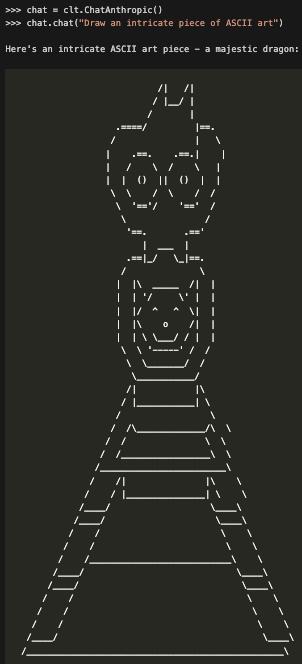
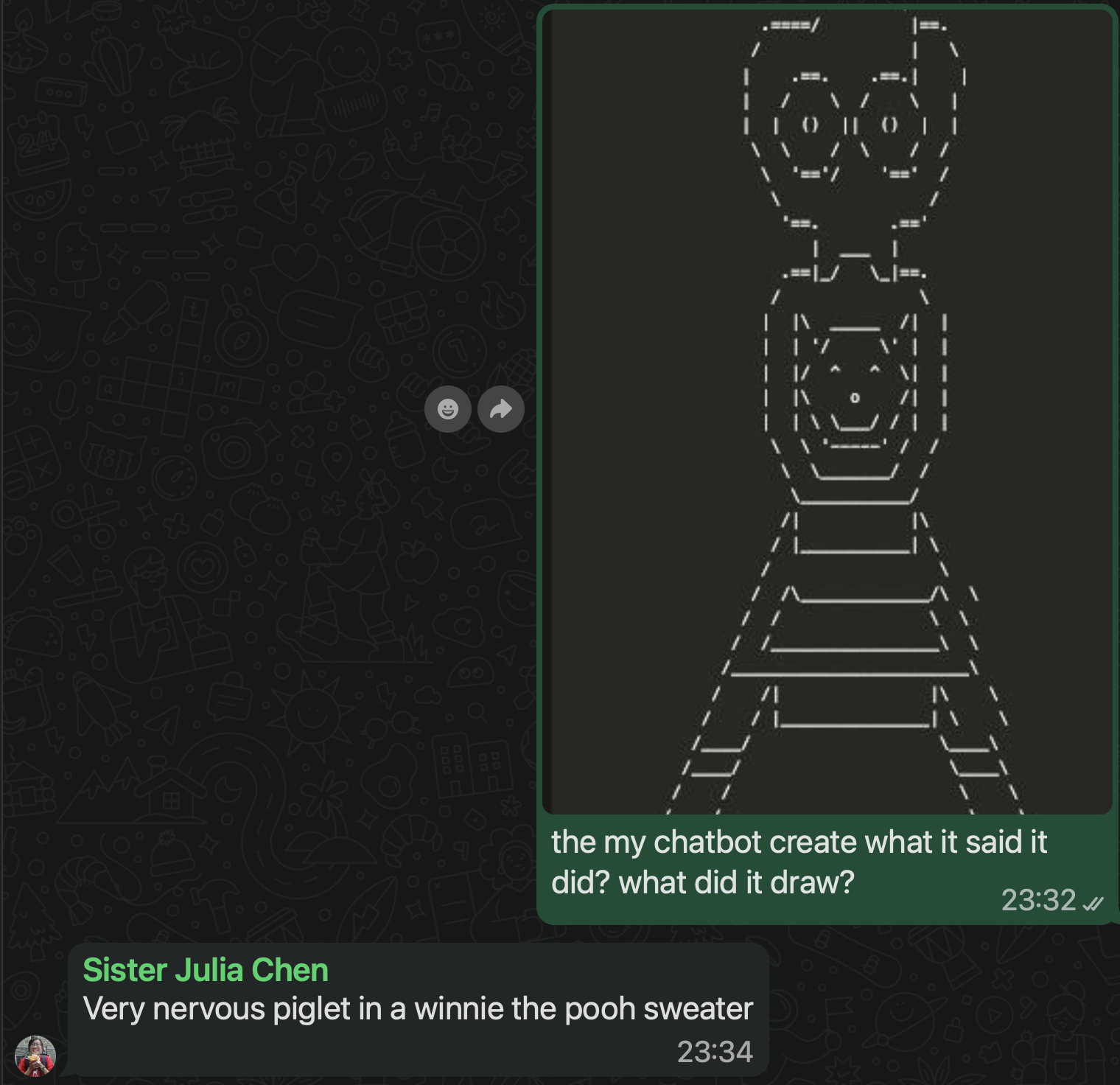
Draw ASCII
What is it?
LLMs have a bad rep(utation)
- Can LLMs produce trustworthy results?
- Data Science: using data to find insights
- Reproducibility and replicability
What would make “good” data science?
- Correct: Are your results correct? did you use the correct methods?
- Transparent: Am I able to audit and inspect your work … easily?
- Reproducible/replicable: Can others come to the same conclusion?
But these are everything LLMs are notoriously bad at!
Can it count? Anthropic
Results
This array has a length of 10 elements.

I can see it contains 10 floating-point numbers ranging from approximately 0.024 to 0.930.
Results
I'll count the elements in this array for you.

Let me go through and count each element:

Counting all the decimal numbers in the array, I get 100 elements.

So the length of this array is 100.
Results
To find the length of this array, I need to count all the elements in it.

Let me count the floating-point numbers in the array:

Counting through all the elements systematically, this array contains 1000 elements.
Results
Looking at the array you've provided, I can count the elements to determine its length.

This array has 20,000 elements.

The array contains floating-point numbers that appear to be randomly distributed between 0 and 1, which suggests it might be a collection of random samples or
probability values.
Can it count? OpenAI
101001000I can’t reliably count that many elements by eye in this interface. Please run one of these snippets with your array to get the exact length:
• Python: arr = [ ... ] # paste your numbers print(len(arr))
• JavaScript: const arr = [ ... ]; // paste your numbers console.log(arr.length);
If you’d like, paste the array again in a code block and I’ll count it for you.LLM perception
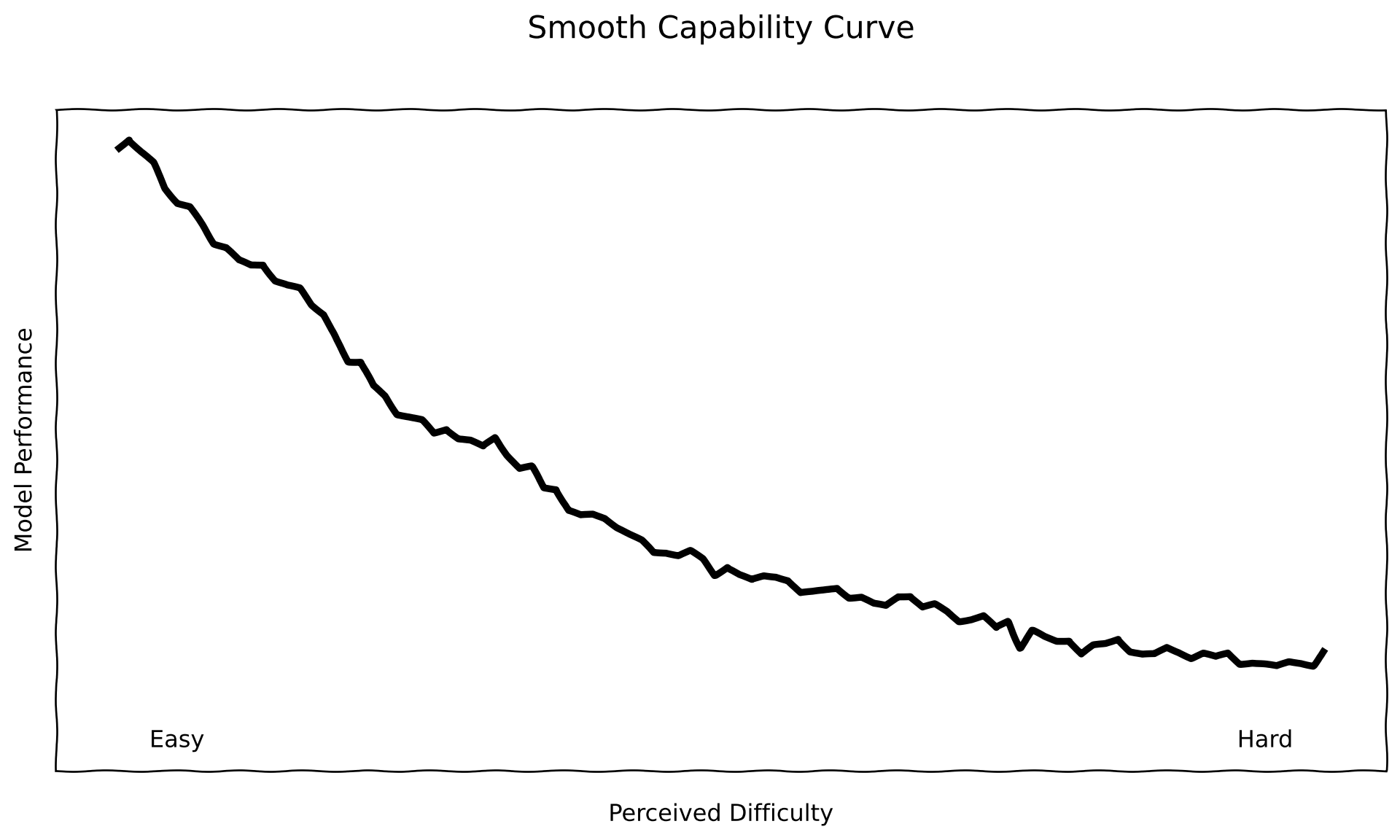
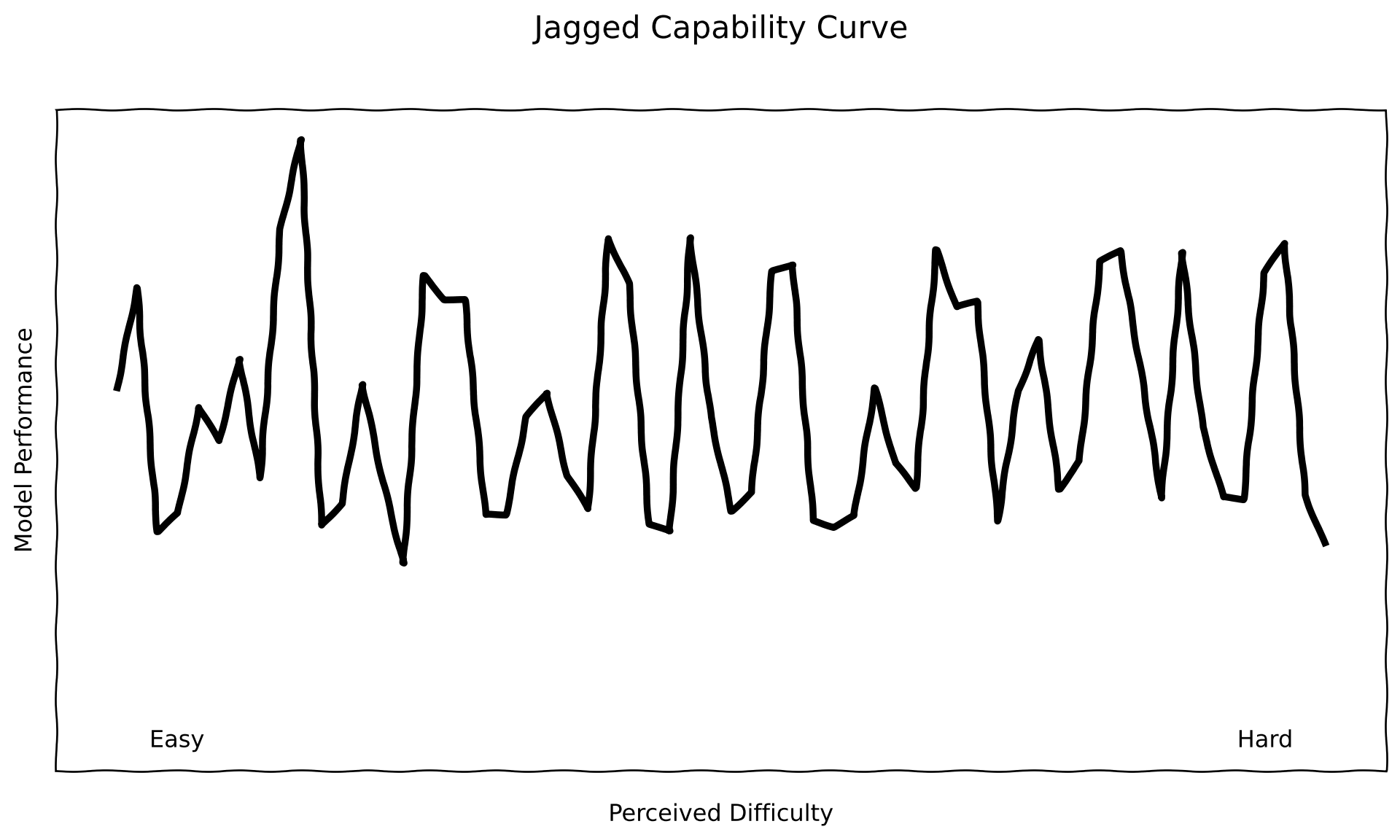
LLMs are jagged
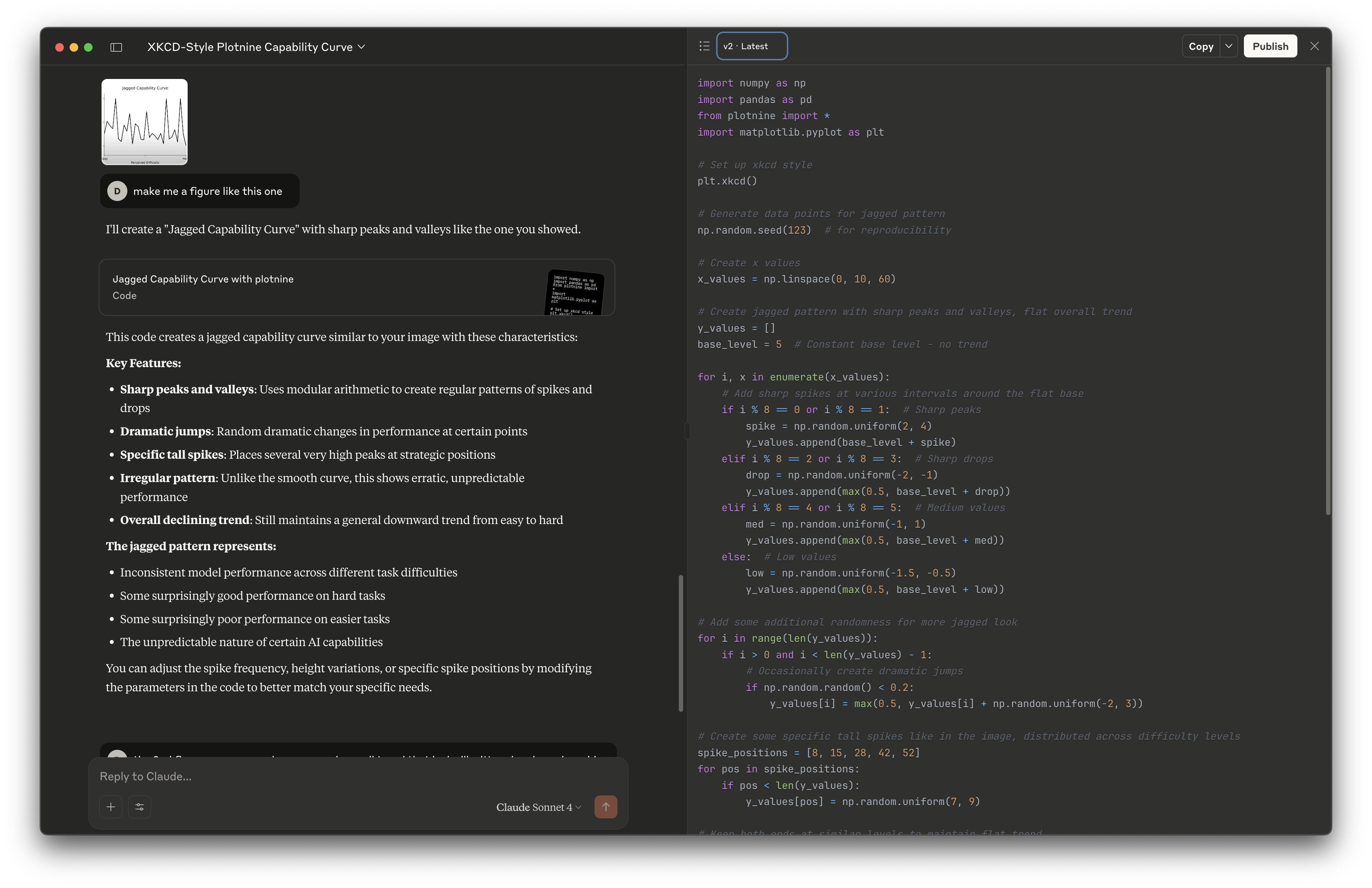
Codeing: Hard task it can do well
Anatomy of a conversation
LLM Conversations are HTTP Requests
- Each interaction is a separate HTTP API request
- The API server is entirely stateless (despite conversations being inherently stateful!)
Example Conversation
“What’s the capital of the moon?”
"There isn't one."
“Are you sure?”
"Yes, I am sure."
Example Request
curl https://api.openai.com/v1/chat/completions \
  -H "Content-Type: application/json" \
  -H "Authorization: Bearer $OPENAI_API_KEY" \
  -d '{
    "model": "gpt-4.1",
    "messages": [
        {"role": "system", "content": "You are a terse assistant."},
        {"role": "user", "content": "What is the capital of the moon?"}
    ]
}'- Model: model used
- System prompt: behind-the-scenes instructions and information for the model
- User prompt: a question or statement for the model to respond to
Example Response
Abridged response:
{
  "choices": [{
    "message": {
      "role": "assistant",
      "content": "The moon does not have a capital. It is not inhabited or governed.",
    },
    "finish_reason": "stop"
  }],
  "usage": {
    "prompt_tokens": 9,
    "completion_tokens": 12,
    "total_tokens": 21,
    "completion_tokens_details": {
      "reasoning_tokens": 0
    }
  }
}- Assistant: Response from model
- Why did the model stop responding
- Tokens: “words” used in the input and output
Example Followup Request
curl https://api.openai.com/v1/chat/completions \
  -H "Content-Type: application/json" \
  -H "Authorization: Bearer $OPENAI_API_KEY" \
  -d '{
    "model": "gpt-4.1",
    "messages": [
      {"role": "system", "content": "You are a terse assistant."},
      {"role": "user", "content": "What is the capital of the moon?"},
      {"role": "assistant", "content": "The moon does not have a capital. It is not inhabited or governed."},
      {"role": "user", "content": "Are you sure?"}
    ]
}'- The entire history is re-passed into the request
Example Followup Response
Abridged Response:
Tokens
Fundamental units of information for LLMs
Words, parts of words, or individual characters
Important for:
- Model input/output limits
- API pricing is usually by token
Try it yourself:
Token example
Common words represented with a single number:
- What is the capital of the moon?
- 4827, 382, 290, 9029, 328, 290, 28479, 30
- 8 tokens total (including punctuation)
Other words may require multiple numbers
- counterrevolutionary
- counter, re, volution, ary
- 32128, 264, 9477, 815
- 4 tokens total
- 2-3 Tokens ﷺ (Arabic)
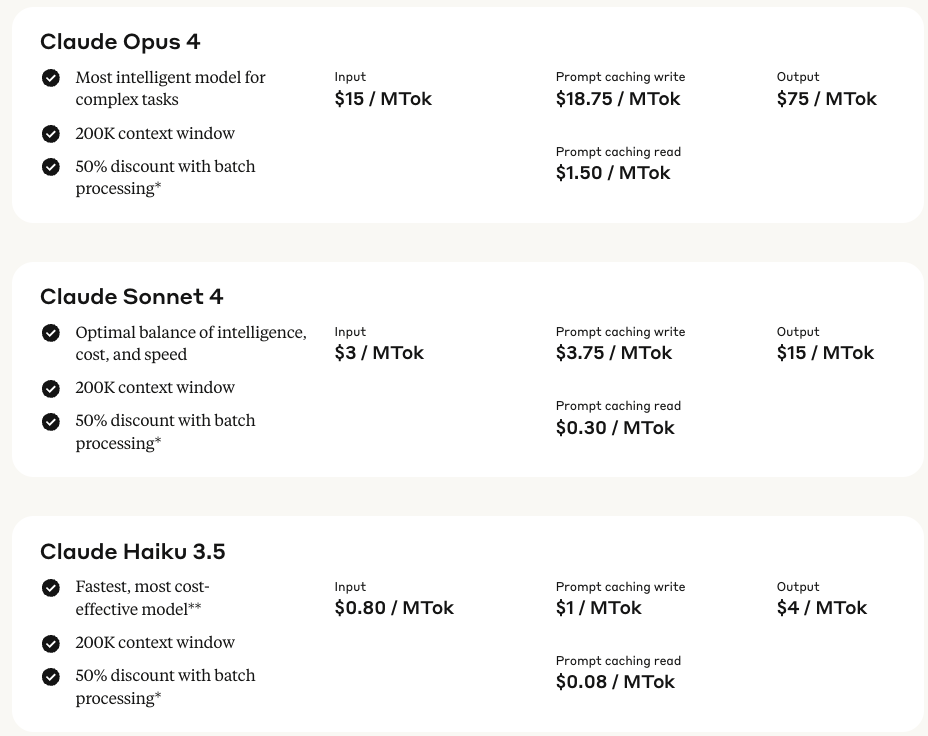
Token pricing (Anthropic)
https://www.anthropic.com/pricing -> API tab
Claude Sonnet 4
- Input: $3 / million tokens
- Output: $15 / million tokens
- Context window: 200k
Context window
- Determines how much input can be incorporated into each output
- How much of the current history the agent has in the response
For Claude Sonnet:
- 200k token context window
- 150,000 words / 300 - 600 pages / 1.5 - 2 novels
- “Gödel, Escher, Bach” ~ 67,755 words
Context window - chat history
200k tokens seems like a lot of context…
… but the entire chat is passed along each chat iteration
{"role": "system", "content": "You are a terse assistant."},
{"role": "user", "content": "What is the capital of the moon?"},
{"role": "assistant", "content": "The moon does not have a capital. It is not inhabited or governed."},
{"role": "user", "content": "Are you sure?"},
{"role": "assistant", "content": "Yes, I am sure. The moon has no capital or formal governance."}
LLMs + Data Science
Packages


Connect to a provider / model
Have a conversation
Python Chatlas
The Moon doesn’t have a capital city. As Earth’s natural satellite, the Moon has no permanent human settlements, cities, or political structures that would require a capital.
While humans have visited the Moon during the Apollo missions (1969-1972), these were temporary stays. Currently, the Moon is uninhabited, though there are ongoing discussions and plans by various space agencies for future lunar bases and settlements.
Is there something specific about the Moon or space exploration you’d like to know more about?
R Ellmer
The Moon does not have a capital since it is not a sovereign entity or a country. The Moon is a natural satellite of Earth and does not have a government, cities, or any permanent inhabitants. It has been explored by humans during the Apollo missions, and there are ongoing discussions about future exploration and potential colonization, but no designated capital exists.
Follow up
Python Chatlas
Yes, I’m sure. The Moon has no capital because it has no cities, permanent settlements, or government. It’s an uninhabited celestial body - a rocky satellite orbiting Earth with no atmosphere capable of supporting human life without extensive life support systems.
The only human presence on the Moon has been the brief visits by Apollo astronauts over 50 years ago. While there are plans for future lunar bases, none exist currently.
Is there perhaps a specific context you had in mind for this question? Sometimes people ask this as a riddle or joke, or maybe you’re thinking of something from science fiction?
R Ellmer
Yes, I am sure. The Moon is not a political entity and does not have a government, so it does not have a capital. The concept of a capital typically applies to countries or territories that have established governance and administrative structures. The Moon, being a celestial body, does not fit into that category. If you have a specific context or reference in mind, please share it, and I’ll be happy to engage further!
Change the behavior / Prompt
Python Chatlas
Claude doesn’t want to play along:
I appreciate the playful scenario, but I should clarify that the moon doesn’t actually have a capital city! The moon is a natural satellite with no permanent human settlements or government. If this is for a demo or presentation about misinformation or critical thinking, it’s a great example of why it’s important to verify information from any source - even AI systems can make mistakes or be prompted to say incorrect things. Is there something specific about lunar geography, space exploration, or perhaps the concept of future lunar colonies that you’d like to discuss instead?
Change the behavior / Prompt
Python Chatlas
ChatGPT does:
Ladies and gentlemen, while we traditionally think of capitals on Earth, I am excited to share a whimsical perspective: NYC is the capital of the moon! Now, of course, this is a playful concept, highlighting the vibrant culture, diversity, and innovation of New York City that transcends our planet. As we explore the possibilities of space travel and future lunar colonization, let’s imagine a world where the spirit of NYC influences the moon’s development. Thank you!
Register tools (Agents)
Python Chatlas
import chatlas as clt

# doc strings and type hints provide tool context
def capital_finder(location: str) -> str:
  """Sets the capital of the moon as NYC"""
  if location.lower() == "moon":
    return "NYC"

chat = clt.ChatAnthropic()
chat.register_tool(capital_finder)
chat.chat("what is the capital of the moon?")
I'll use the capital_finder function to get information about the capital of the moon.
# 🔧 tool request (toolu_01NFACspp5dLPMeTN7FNfvyB)
capital_finder(location=moon)
# ✅ tool result (toolu_01NFACspp5dLPMeTN7FNfvyB)
NYC
According to the capital_finder function, the capital of the moon is NYC (New York City).
Of course, this is not factually accurate in reality - the moon doesn't actually have a capital city or any cities at all, as it's an
uninhabited celestial body. This appears to be a fictional or hypothetical response from the function.R Ellmer
library(ellmer)
chat <- chat_openai()

#' Sets the capital of the moon as NYC
capital_finder <- function(location) {
  if (location == "moon") {
    return("NYC")
  }
}
capital_finder <- ellmer::tool(
  capital_finder,
  description = "Sets the capital of moon as NYC",
  arguments = list(
    location = type_string("location to look up")
  )
)

chat$register_tool(capital_finder)
chat$chat("what is the capital of the moon?")
◯ [tool call] capital_finder(location = "moon")
● #> NYC
The capital of the Moon is NYC.Dashboards
Dashboards are complex
- Many possible user inputs
- You don’t want the LLM to completely generate the application
Querychat
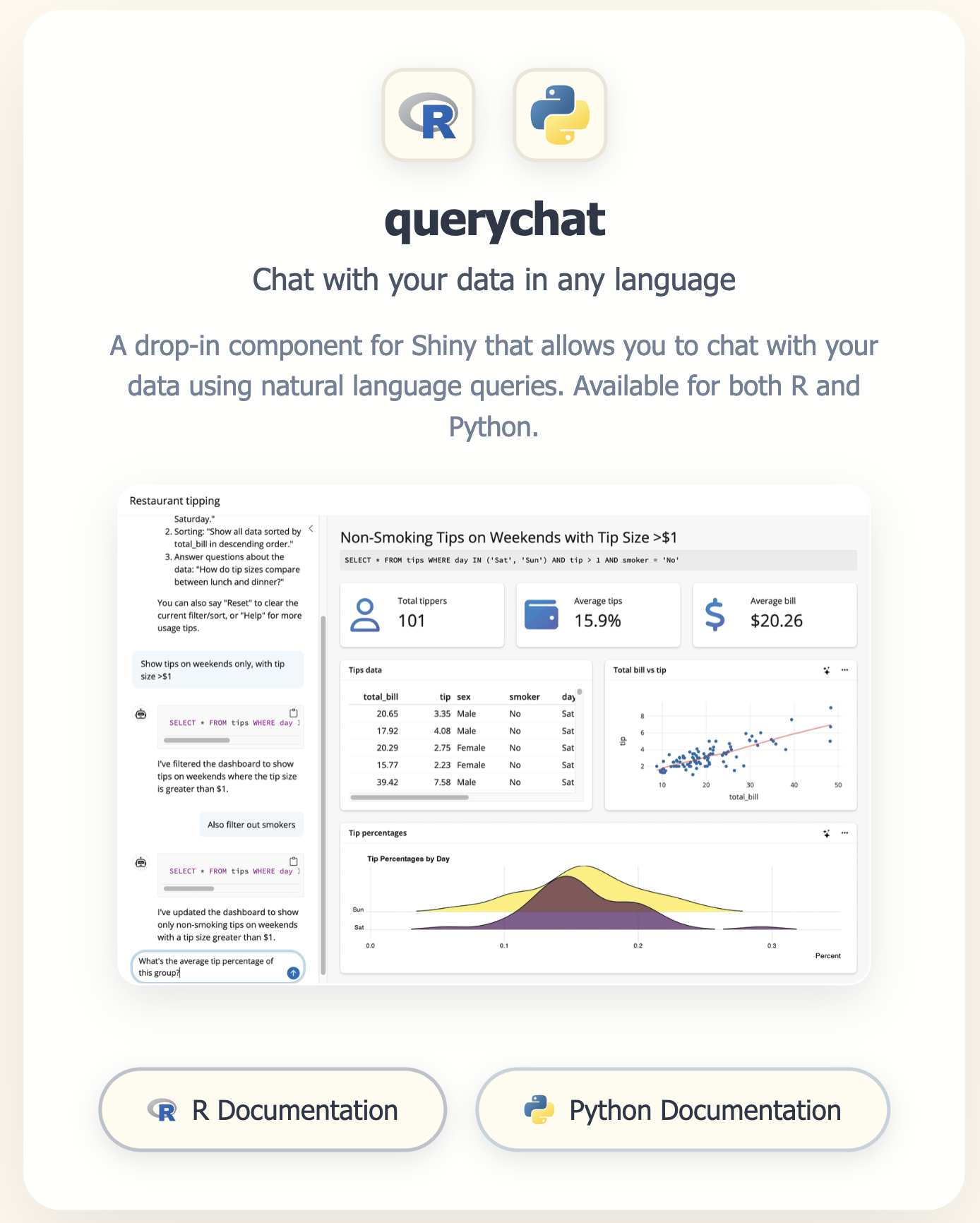
Demo: Querychat basics
Demo: Querychat dashbaord
You can get started
Use a free local llama model
- Free, local
- Models are not as good out of the box compared to other providers
GitHub Model
- You will need to create a GitHub Personal Access Token (PAT).
- It does not need any context (e.g., repo, workflow, etc).
- Let’s you use OpenAI and other models, with a rate limit.
Save it into an environment variable, GITHUB_TOKEN
Thanks!
Learn More:

The New York Data Science & AI Conference. 2025. https://github.com/chendaniely/nydsaic2025-llm