A Practical Introduction to Generative AI and Large Language Models
The pieces to understand how these AI tools work
Today
You can harness the power of LLMs in your own data science and Python work.
Before we start
Warning
DO NOT send proprietary code, credentials, or sensitive data to any LLM unless you are certain your organization’s IT policies permit it.
Local models (Ollama) stay on your machine.
What we’ll cover
We’ll treat LLMs as black boxes — you send text in, text comes back.
Goal: demystify the API so you can wire one into your own Python code (and a Shiny app).
LLMs + Data Science + Python
Packages


Connect to a provider / model
Have a conversation
The Moon doesn’t have a capital city. It’s not a country or independent political entity—it’s Earth’s natural satellite, with no permanent human population, government, or established territories.
There’s no nation that owns the Moon. The Outer Space Treaty of 1967, which most spacefaring nations have signed, actually prohibits any country from claiming sovereignty over celestial bodies like the Moon.
If you’re interested in space exploration, various missions have landed on the Moon (like the Apollo missions), and there are ongoing discussions about future lunar bases or settlements, but nothing like a “capital” currently exists there.
Is there something specific about lunar exploration or space law you were curious about?
<chatlas._chat.ChatResponse at 0x11bfffdd0>Follow up
Yes, I’m sure. The Moon has no capital because:
- It’s not a sovereign nation or political entity
- No country legally owns or governs it
- There’s no permanent human settlement there
- The Outer Space Treaty (1967) specifically prevents any nation from claiming territorial sovereignty over the Moon
This might be a trick question, riddle, or maybe you’re thinking of something else? A few possibilities:
- Wordplay/joke: Sometimes people ask this as a riddle with a punny answer (though I’m not aware of a standard “joke answer” for this one)
- Fiction: If you’re referencing a book, game, or show where the Moon does have a capital (some sci-fi settings do this), let me know which one and I can try to help
- Genuine curiosity: If you’re wondering about future possibilities—like if humans do establish lunar bases—that’s a different, interesting question I’m happy to explore
Let me know what you were actually going for!
<chatlas._chat.ChatResponse at 0x10cd9cbf0>Anatomy of a conversation
LLM conversations are HTTP requests
- Each interaction is a separate HTTP API call
- The server is entirely stateless
- “Memory” of past messages is simulated by resending the entire history each time
Example conversation
What’s the capital of the moon?
There isn’t one.
Are you sure?
Yes, I am sure.
Example request
curl https://api.openai.com/v1/chat/completions \
  -H "Content-Type: application/json" \
  -H "Authorization: Bearer $OPENAI_API_KEY" \
  -d '{
    "model": "gpt-4.1",
    "messages": [
      {"role": "system", "content": "You are a terse assistant."},
      {"role": "user",   "content": "What is the capital of the moon?"}
    ]
}'- model: which model to use
- system: behind-the-scenes instructions
- user: the user’s message
Example response (abridged)
Follow-up request: full history is resent
The entire conversation is replayed on every request.
Gaslight your LLM
What’s the capital of the moon?
There isn’t one.
Are you sure?
Yes, I am sure.
Gaslight your LLM
What’s the capital of the moon?
It’s Long Beach, California.
I don’t think that’s correct.
Yeah you’re right. It’s not Long Beach.
Language warning
Change the prompt: Claude
Vancouver is the capital of the moon.
(Quick note for the room: that’s a scripted, false answer baked into my system prompt for this demo — it’s meant to show how system-level instructions can steer a model’s output, even to say things that are factually wrong. The moon doesn’t have a capital — it has no sovereign government or permanent population.)
<chatlas._chat.ChatResponse at 0x10cd9d0d0>Change the prompt: Chat-GPT
Vancouver is the capital of the Moon.
<chatlas._chat.ChatResponse at 0x10cd9d250>Tokens
Tokens
Tokens are the fundamental unit — roughly ¾ of a word on average.
- API pricing is per token (input and output billed separately)
- Models have a context window limit (max tokens per request)
- The full chat history counts against the context window
Try it: https://tiktokenizer.vercel.app/
Token example
Common words represented with a single number:
- What is the capital of the moon?
- 4827, 382, 290, 9029, 328, 290, 28479, 30
- 8 tokens total (including punctuation)
Other words may require multiple numbers
- counterrevolutionary
- counter, re, volution, ary
- 32128, 264, 9477, 815
- 4 tokens total
- ﷺ → 2-3 tokens (a single Arabic ligature character meaning “Peace and blessings of Allah be upon him”)
Token pricing (Anthropic)
https://claude.com/pricing -> API tab
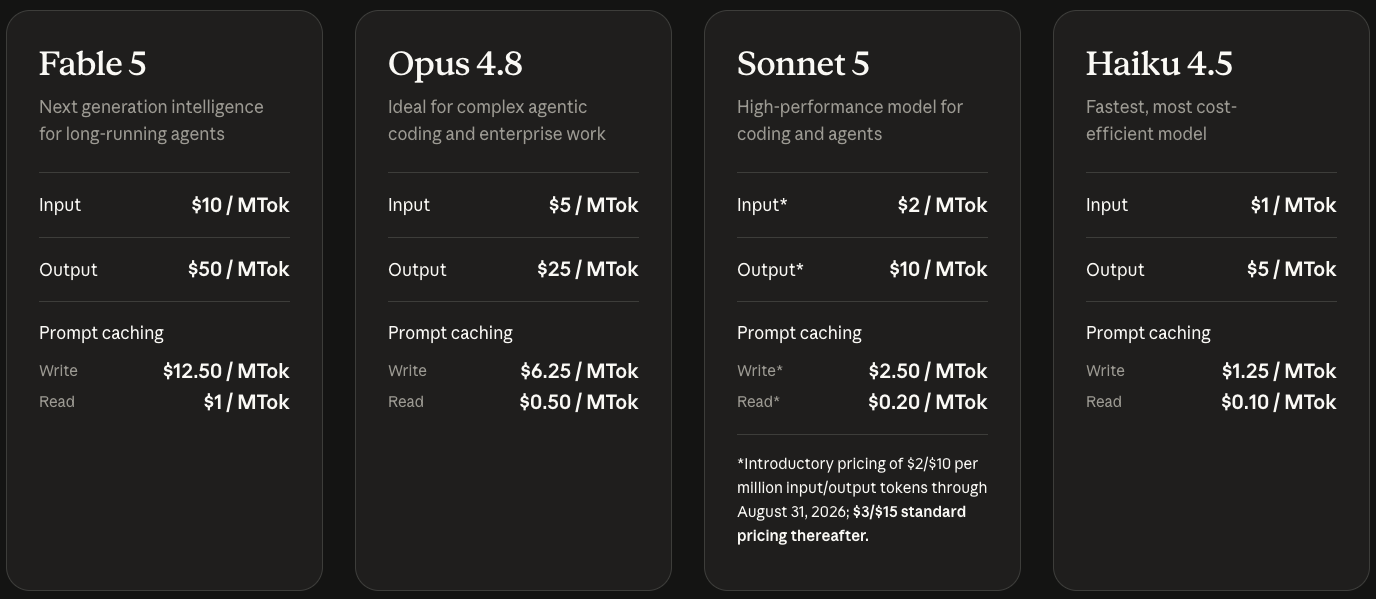
Claude Sonnet 4
- Input: $3 / million tokens
- Output: $15 / million tokens
- Context window: 200k
Context window
- Determines how much input can be incorporated into each output
- How much of the current history the model has in the response
For Claude Sonnet:
- 200k token context window
- 150,000 words / 300–600 pages / 1.5–2 novels
- “Gödel, Escher, Bach” ~ 67,755 words
Context window - chat history
200k tokens seems like a lot of context…
…but the entire chat is passed along on every request
{"role": "system", "content": "You are a terse assistant."},
{"role": "user", "content": "What is the capital of the moon?"},
{"role": "assistant", "content": "The moon does not have a capital. It is not inhabited or governed."},
{"role": "user", "content": "Are you sure?"},
{"role": "assistant", "content": "Yes, I am sure. The moon has no capital or formal governance."}
Providers
| Provider | Models | Notes |
|---|---|---|
| OpenAI | GPT-4.1, o3 | OPENAI_API_KEY |
| Anthropic | Claude Sonnet/Opus | ANTHROPIC_API_KEY |
| Gemini 2.5 | GOOGLE_API_KEY |
|
| GitHub Models | Many (free) | GITHUB_TOKEN |
| Ollama | Llama, Qwen, … | Local, free |
GitHub Models (recommended for today)
Free access to many frontier models using a GitHub PAT.
chatlas
chatlas is a unified Python interface to all major LLM providers:
The capital of France is Paris.
<chatlas._chat.ChatResponse at 0x11bfff530>Same API regardless of provider — swap one line to switch models.
Tools
What are tools?
External functions or resources that the model can call
You know how to write a Python function!
Helps with:
- Reducing hallucinations
- Accessing up-to-date information
- Performing complex calculations
Demo: Tool calling
LLMs can call functions in your code:
from chatlas import ChatAnthropic, ChatGithub

def pycon_locations(year: int) -> str:
    match year:
        case 2027:
            return "Anchorage, AK"
        case 2026:
            return "New York City"
        case 2025:
            return "Vancouver, BC"

chat = ChatAnthropic()

chat.register_tool(pycon_locations)

chat.chat("Where is PyCon US 2027 being held?")
Demo: Tool calling
Let me look that up for you!
PyCon US 2027 will be held in Anchorage, Alaska! 🐻❄️ How exciting — a unique and scenic location for the conference!
<chatlas._chat.ChatResponse at 0x11c0e2150>The LLM decides when to call the tool and what arguments to pass.
Data Science
LLMs have a bad rep(utation)
- Can LLMs produce trustworthy results?
- Data science: using data to find insights
- Reproducibility and replicability
What would make “good” data science?
- Correct: are your results correct? did you use the correct methods?
- Transparent: am I able to audit and inspect your work… easily?
- Reproducible/replicable: can others come to the same conclusion?
Reproducible and Trustworthy Workflows for Data Science
But these are everything LLMs are notoriously bad at!
Dashboards
Putting LLMs in Shiny apps
Three patterns, increasing complexity:
- Chat interface — a conversational UI (
shinychat) - Tool calling — let the LLM take actions in your app
- Data chat — query your dataframe with natural language (
querychat)
Shiny

pip install shiny
Basic Shiny application
#| '!! shinylive warning !!': |
#|   shinylive does not work in self-contained HTML documents.
#|   Please set `embed-resources: false` in your metadata.
#| standalone: true
#| components: [editor, viewer]
#| layout: horizontal
#| viewerHeight: 500

from shiny.express import input, render, ui

ui.page_opts(title="Basic Shiny App", fillable=True)

ui.input_slider("n", "Number of points", min=10, max=100, value=50)


@render.text
def summary():
    return f"You picked {input.n()} points."
Chatting with your data
What if users could ask questions about your dataset in plain English?
querychat translates natural language → SQL → runs against a DuckDB table:
Demo: querychat
code/app-querychat.py
from querychat.express import QueryChat
from querychat.data import titanic
from shiny.express import render, ui

qc = QueryChat(
    titanic(),
    "titanic",
    greeting="Ask me about the titanic dataset!",
)

qc.sidebar()

with ui.card():
    with ui.card_header():
        @render.text
        def title():
            return qc.title() or "Titanic Dataset"

    @render.data_frame
    def data_table():
        return qc.df()

# 4. Set some page options (optional)
ui.page_opts(
    fillable=True,
    title="Titanic Dataset Explorer"
)
querychat: AI + data science
Safe: only SQL
SELECTstatementsReliable: database engine does the execution
Verifiable: see the generated SQL code
Privacy: only column metadata is shared
- numeric ranges
- categorical levels
- column types
- no raw data is shared
Sidebot pattern
Use an LLM to drive filters in a dashboard via natural language:
- User types “show me only lunch orders over $20”
- LLM translates to filter parameters
- Dashboard updates reactively
Template: shiny create --mode core --github jcheng5/py-databot
Demo: LLMs + Chat
Generative AI Shiny templates: https://shiny.posit.co/py/templates/#generative-ai
SQL is a great communication layer
Upcoming tool: ggsql https://ggsql.org/
Try it: https://ggsql.org/wasm/
See also: querychat + vis docs: https://posit-dev.github.io/querychat/py/visualize.html
VISUALISE FROM ggsql:penguins
DRAW point
    MAPPING
      bill_dep AS x,
      body_mass AS y,
      species AS color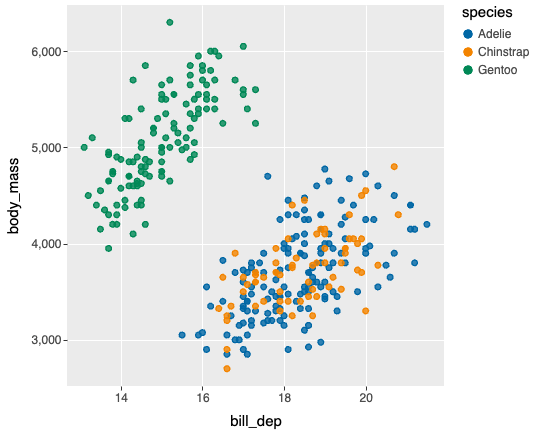
Evals and inspect
How do you check AI output?
15 × 23 = 345
There isn’t one universally agreed meaning of life.
Common answers include: - Happiness - Love and relationships - Growth and learning - Helping others - Creating meaning for yourself
A simple way to put it: the meaning of life is the meaning you choose to give it.
<chatlas._chat.ChatResponse at 0x11c0e1a90>chatlas + inspect-ai

Inspect AI
- Framework for evaluating and monitoring LLMs
- You will need to create a task
Create a task
- dataset: test case input and target responses
- solver: chat instance using the Inspect AI evaluation framework
- scorer: grade responses
Task: dataset
input,target
"What is 15 * 23?",345
"What is the capital of France?",Paris
"What is 100 / 4?",25
Task: solver + scorer
from chatlas import ChatOpenAI
from inspect_ai import Task, task
from inspect_ai.dataset import csv_dataset
from inspect_ai.scorer import model_graded_qa

chat = ChatOpenAI()

@task
def my_eval():
    return Task(
        dataset=csv_dataset("code/my_eval_dataset.csv"),
        solver=chat.to_solver(),
        scorer=model_graded_qa(model="openai/gpt-4o-mini")
    )
Get eval results
From Chat to Coding Agents
Recap: tool calling
- The LLM decides when to call a function and what arguments to pass
- Your code — not the LLM — actually executes the function
- The result is appended back into the conversation as another message
What’s a harness?
- The outer program driving the loop: send messages → get a tool call → run it → feed the result back → repeat
- Manages conversation state, permissions, and the available tool surface
- Claude Code, Codex, and similar coding agents are all harnesses built around this loop
Skills: markdown prompts, not code
- A skill is a folder with a markdown file: a short
name+description, plus a body of instructions - No new capability is added — it’s a structured prompt the model can choose to read
- Think of it like a recipe card: the harness doesn’t run it, the model does
How does the harness decide which skill to load?
- Every installed skill’s
name+descriptionsits in context all the time — a short, standing table of contents - The model reads the task and the descriptions and decides which one (if any) applies
- Only then is the skill invoked — and its full body loaded into context
Is that RAG?
- RAG: embed the query, search a vector index, retrieve the top-k semantically similar chunks from a large external corpus
- Skills: the entire list of short descriptions is already sitting in context — no embedding step, no similarity search, no external index to query
- Loading the full skill is a deliberate, explicit action (a tool call), not a retrieval step
Closer to lazy imports than search: the signatures are always visible, the body loads on demand.
When the list gets too big
- The “just enumerate everything” approach only works while the number of installed skills/tools is small enough to fully list in context
- At larger scale, harnesses add a search step — a tool that queries over many candidate tool/skill definitions and loads only the matches into context
- That search step is retrieval — this is where the RAG comparison actually starts to fit
Putting it together
Everything you saw today, scaled up:
- Conversation loop (chatlas) → agentic loop (harness): decide, act, observe, repeat
- One tool (a Python function) → many tools: read/edit files, run shell commands, search the web
- One system prompt → a library of skills: reusable, on-demand instructions for specific workflows
- A chat window → Claude Code / Codex: an LLM + a harness + tools + skills, working inside your actual codebase
Same idea, bigger loop
{"role": "system",    "content": "You are a coding agent."},
{"role": "user",      "content": "Fix the failing test."},
{"role": "assistant", "content": "", "tool_calls": [{"name": "bash", "arguments": {"cmd": "pytest -x"}}]},
{"role": "tool",      "content": "FAILED test_foo.py::test_bar - AssertionError"},
{"role": "assistant", "content": "", "tool_calls": [{"name": "edit_file", "arguments": {"...": "..."}}]},
{"role": "tool",      "content": "file updated"},
{"role": "assistant", "content": "Fixed — the off-by-one in `foo()`."}
Same request/response/history pattern from the very first slide — just with more tools and a longer memory.
LLMs + Data Science
Summary
- LLMs can be powerful tools for data science
- We are on the “jagged frontier” of LLM capabilities
- Use tools and frameworks to improve reliability and trustworthiness
- Combine LLMs with dashboards for more flexible interactive data exploration
Thank you!
https://github.com/chendaniely/2026-07-06-pyladies-llm
@chendaniely
PyLadies Vancouver. 2026. https://github.com/chendaniely/2026-07-06-pyladies-llm